Sustainability Knowledge Test
Assessing and Advancing Sustainability Literacy
Sustainability is not only a guiding principle but a measurable commitment embedded across education, research, operations, and community engagement. To ensure that students and staff are equipped with the knowledge and skills needed to contribute to a sustainable future, ANNU has established a comprehensive Sustainability Literacy Test.
This assessment is designed to evaluate understanding of the 17 United Nations Sustainable Development Goals (SDGs), covering essential concepts such as definitions, global relevance, key challenges, root causes, and practical strategies for mitigation and adaptation. The test goes beyond theoretical knowledge, emphasizing critical thinking, real-world application, and informed decision-making.
To enhance accuracy and relevance, the assessment is tailored into two versions—one for students and another for staff. Each version incorporates scenario-based questions, campus- specific case studies, and indicators that measure not only knowledge but also attitudes and behaviors toward sustainability. The test is delivered bilingually (Arabic and English) through ANNU’s digital platforms, ensuring accessibility and inclusivity, while adhering to strict data ethics standards, including confidentiality and responsible use of results.
Measuring Progress and Driving Improvement
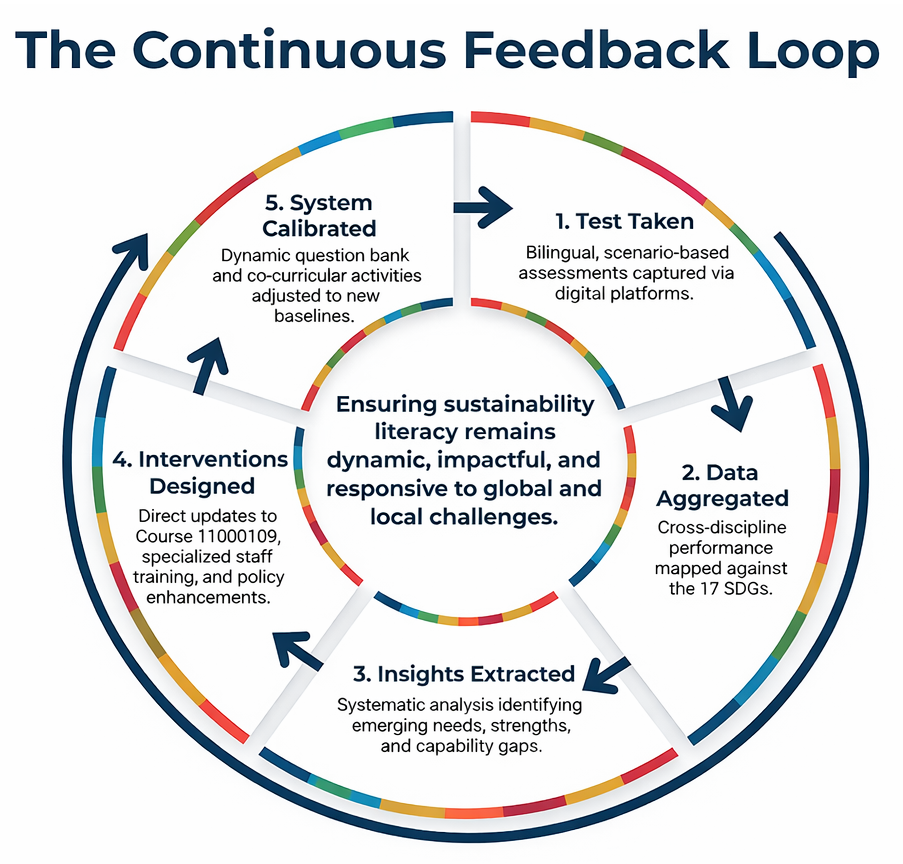
ANNU adopts a structured approach to sustainability literacy assessment through pre- and post-testing, enabling the University to track knowledge development over time. Results are analyzed across faculties and disciplines to establish benchmarks, identify strengths and gaps, and inform continuous improvement. Findings directly support curriculum development, staff training, and co-curricular activities, ensuring alignment with international best practices and institutional quality assurance processes.
Assessment Strategies for Students and Staff
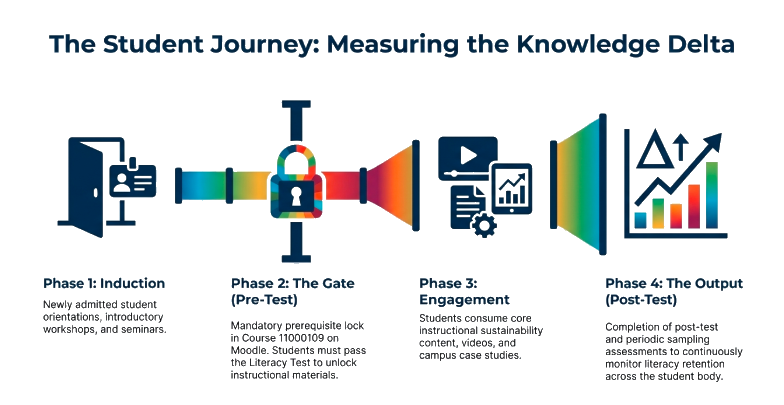
Sustainability is deeply integrated into the student learning experience. All students enrolled in the Community Service and Sustainability course (11000109) are required to complete the literacy test as part of their academic journey. In addition, newly admitted students are introduced to sustainability concepts through orientation programs, workshops, and seminars. Engagement is further strengthened through volunteer work, awareness campaigns, and student-led initiatives.
For staff, sustainability assessment is embedded within professional development through targeted workshops, annual sustainability surveys, and departmental sustainability planning. Staff are also actively involved in interdisciplinary research, partnerships, and the integration of sustainability concepts into teaching and curricula.
Student Evaluation Method
The student sustainability literacy test, developed by the Sustainability Steering Committee, covers environmental, social, and economic dimensions of sustainability. A dynamic question bank ensures a unique test experience for each student. Delivered by Moodle, the test is a prerequisite for accessing instructional sustainability content, including educational videos.
Students complete the assessment before and after engaging with learning materials, allowing ANNU to measure learning outcomes and knowledge progression. Additional periodic sampling assessments are conducted to ensure continuous monitoring and enhancement of sustainability literacy across the student body.
Staff Evaluation Method
ANNU evaluates staff sustainability literacy through structured assessments, surveys, and training workshops. These tools measure awareness of sustainability concepts, policies, and their application within professional roles. Staff participation in sustainability training programs and curriculum integration is strongly encouraged, with results guiding the development of targeted capacity-building initiatives and institutional policies.
Analysis and Utilization
Assessment data is systematically analyzed to identify strengths, gaps, and emerging needs. The insights gained are used to design targeted educational programs, enhance institutional policies, and strengthen sustainability integration across all university functions. Through this continuous feedback loop, ANNU ensures that sustainability literacy remains dynamic, impactful, and responsive to global and local challenges.